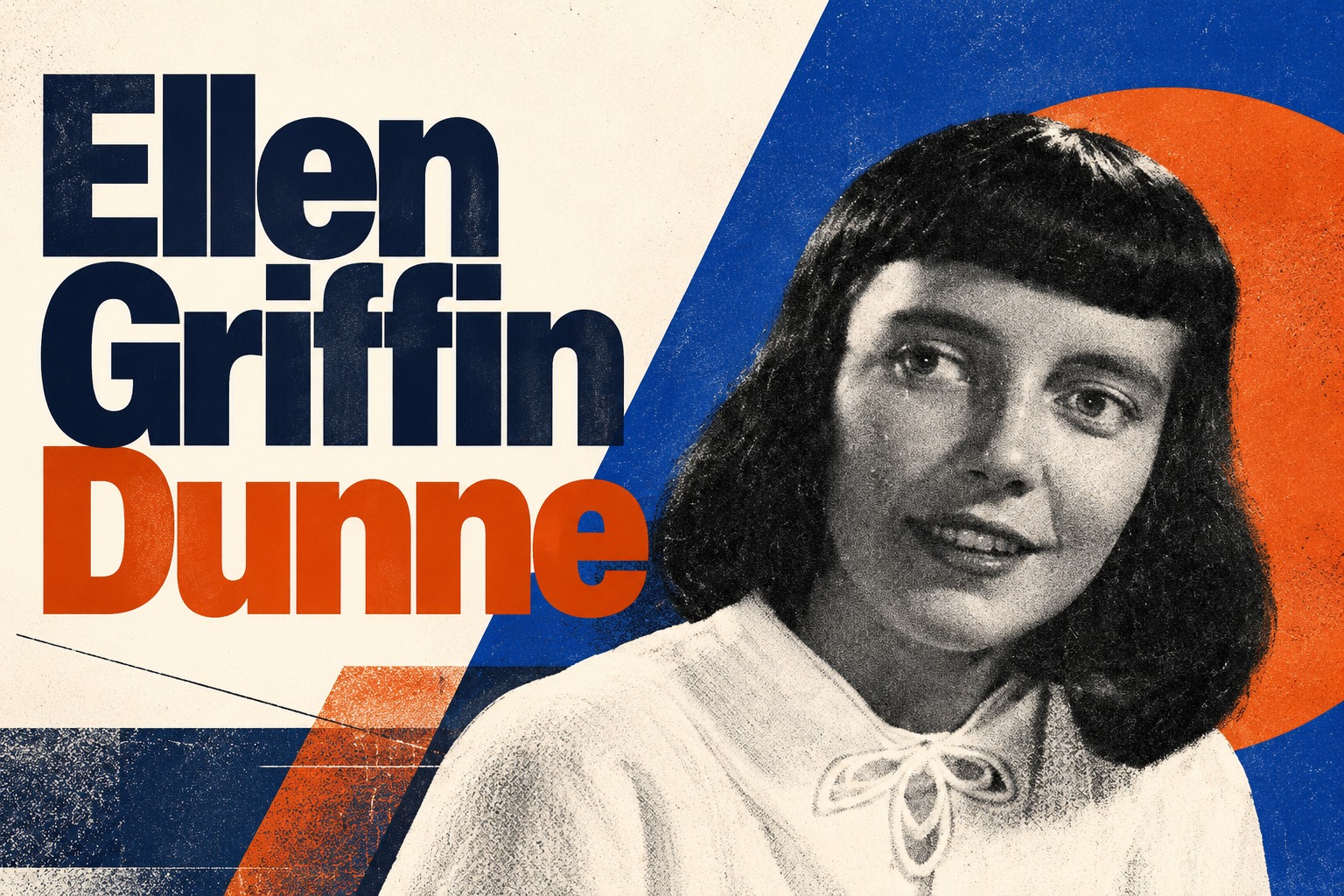
Ellen Griffin Dunne’s life changed course after the killing of her daughter Dominique in 1982. I see her subsequent advocacy as a defining achievement, but it belongs within a fuller biography that began in Arizona and included education, marriage, motherhood, and years in Hollywood society. She was not simply a grieving figure beside a famous writer. She helped create an organization that offered other bereaved families support and a public voice.
Born Ellen Beatriz Griffin on January 28, 1932, she was known to her family as Lenny. Her birthplace was the Yerba Buena ranch near Tucson, Arizona. Her parents, Thomas Francis Griffin and Beatriz Sandoval Griffin, connected her to a family history that crossed regional and cultural boundaries. Her mother came from Nogales, Sonora, while her father’s background included the industrial Griffin family.
Arizona Origins and an Interest in Drama
Ellen attended Miss Porter’s School and Briarcliff College, then studied drama at the University of Arizona. I find the drama studies a useful detail in a family later associated with actors, filmmakers, and writers. They show that performance was present in her own education before her children’s careers, although they do not establish a professional acting career for her.
Arizona remained important across her lifetime. She began near Tucson and eventually returned to the state, living in Nogales in her later years. Between those points came New York and Beverly Hills, marriage to Dominick Dunne, and a public life that changed dramatically. The geography forms an arc, with Arizona at both ends and the entertainment world occupying much of the middle.
Her early social position and family background helped place her within prominent circles. Yet the later advocacy cannot be reduced to social access. It involved building a response to homicide that included families beyond her own. That shift is the most substantial movement in her biography: from being visible within society to organizing around a cause.
Marriage to Dominick Dunne
Ellen married Dominick Dunne in 1954 at the Griffin family ranch. The couple lived in New York and later Beverly Hills. Dominick worked in Hollywood as a producer and subsequently became a writer and journalist, particularly known for covering criminal trials. Their marriage ended in divorce in 1965, but their connection through their children continued.
I keep the marriage dates clear because later accounts often place Ellen beside Dominick during events that occurred long after the divorce. Their shared response to Dominique’s death did not mean they were still married in 1982. It meant they remained parents of the same daughter, carrying a loss that reached across the separation.
Dominick’s writing eventually gave him a powerful public platform for discussing victims and criminal proceedings. Ellen pursued another route through direct advocacy and organizational work. Their activities were connected by family experience, but Ellen’s role should not disappear into his more widely circulated prose. Her work had its own institutional form and its own recognition.
Griffin Alex and Dominique
Griffin Dunne, born in 1955, is Ellen and Dominick’s son. He became an actor, director, and producer, with acting work including An American Werewolf in London and After Hours. Another son, Alexander, generally called Alex, lived with a lower public profile. I include both because the family’s story is sometimes narrowed to its best known performers.
The couple also lost two daughters in infancy before Dominique’s birth. Those losses belong to the family history without needing invented names or circumstances. Dominique later became an actress and appeared in Poltergeist. Her career was still young when violence ended her life in 1982.
Ellen also became a grandmother. Hannah Dunne, born in 1990, is Griffin’s daughter with Carey Lowell and later became an actress. That relationship adds another generation to the family. Carey belongs here as Hannah’s mother, while Hannah’s connection to Ellen runs through Griffin. Each link matters when several recognizable surnames appear in the same family narrative.
Dominique’s Death and the Demand for Change
Dominique was strangled by an ex boyfriend on October 30, 1982, and died a few days later after life support was withdrawn. The criminal case resulted in a voluntary manslaughter conviction and a sentence whose effective duration deeply distressed the family.
For Ellen, the aftermath became a starting point for work with other families of homicide victims. She helped establish the California Center for Family Survivors of Homicide in the period following the case. The organization became known as Justice for Homicide Victims. Marcella Leach was another cofounder associated with this work.
The organization combined emotional support with a demand that victims’ families receive greater recognition and protection. I see those functions as closely connected. A court case may determine a legal outcome, while the family still has to live with the loss. Ellen helped create a place where that continuing experience could be acknowledged rather than treated as something that ended with sentencing.
Recognition and Later Life
Ellen’s advocacy received public recognition, including national victims’ rights recognition in 1989. The organization continued its work into the 1990s, providing support to people whose loved ones had been murdered. Its continuing history gives substance to her legacy beyond the Dunne family’s own case.
Ellen lived with multiple sclerosis in her later years and returned to Arizona. She died in Nogales on January 9, 1997, shortly before her 65th birthday. I regard that later period as part of the same biography, with health and family circumstances alongside the advocacy. The organization continued under other leaders, while her role in its founding remained significant.
Griffin’s memoir The Friday Afternoon Club brought renewed attention to Ellen in 2024 and the subsequent publicity period. Family recollections revisited both the tragedies and the work that followed. That renewed attention concerns her historical life; it does not create new events in a biography that ended in 1997.
FAQ
What was Ellen Griffin Dunne known for?
Ellen was known for cofounding the organization that became Justice for Homicide Victims after her daughter Dominique’s killing. She was also part of the Dunne family’s Hollywood social history. I place her advocacy at the center of her public achievement because it created support for families beyond her own.
Who were Ellen’s children?
Her children with Dominick Dunne included Griffin, Alex, and Dominique, as well as two daughters who died in infancy. Griffin became an actor and filmmaker, while Dominique became an actress before her death in 1982. Alex has generally had a more private public profile.
Was Ellen still married to Dominick when Dominique died?
No. Ellen and Dominick married in 1954 and divorced in 1965. They remained connected through their children and shared the devastating loss of Dominique in 1982. Their later public involvement in the aftermath should not be confused with a continuing marriage.